Benchmark Results - Problem C1
I. Problem Description
A. Overall Approach
Vectors are 2-dimensional and have...
- first component drawn from a uniform distribution over \([0, 1]\),
- second component drawn from a standard normal distribution \(\mathcal{N}(0, 1)\).
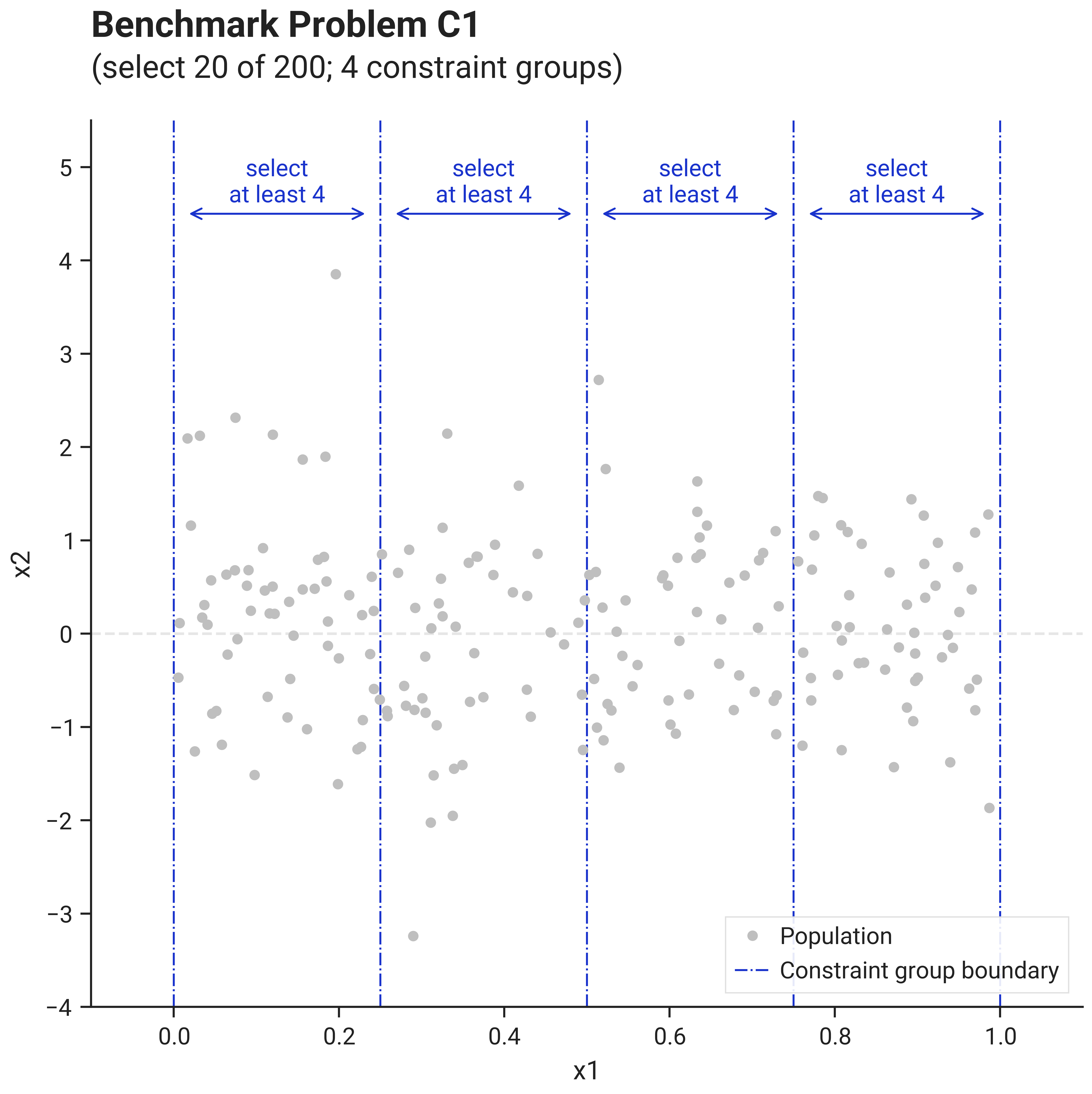
All vectors are split in \(m=2s\) non-overlapping groups, by splitting the range \([0, 1]\) of the first component into \(m\) equal segments. From each group between \(4\) and \(k\) vectors need to be selected. This is always feasible, since \(k=5m\) and \(n=50m\).
B. Visualization
This image shows problem C1 with size parameter \(s=2\) (thus \(d=2\), \(n=200\), \(k=20\), \(m=4\)):
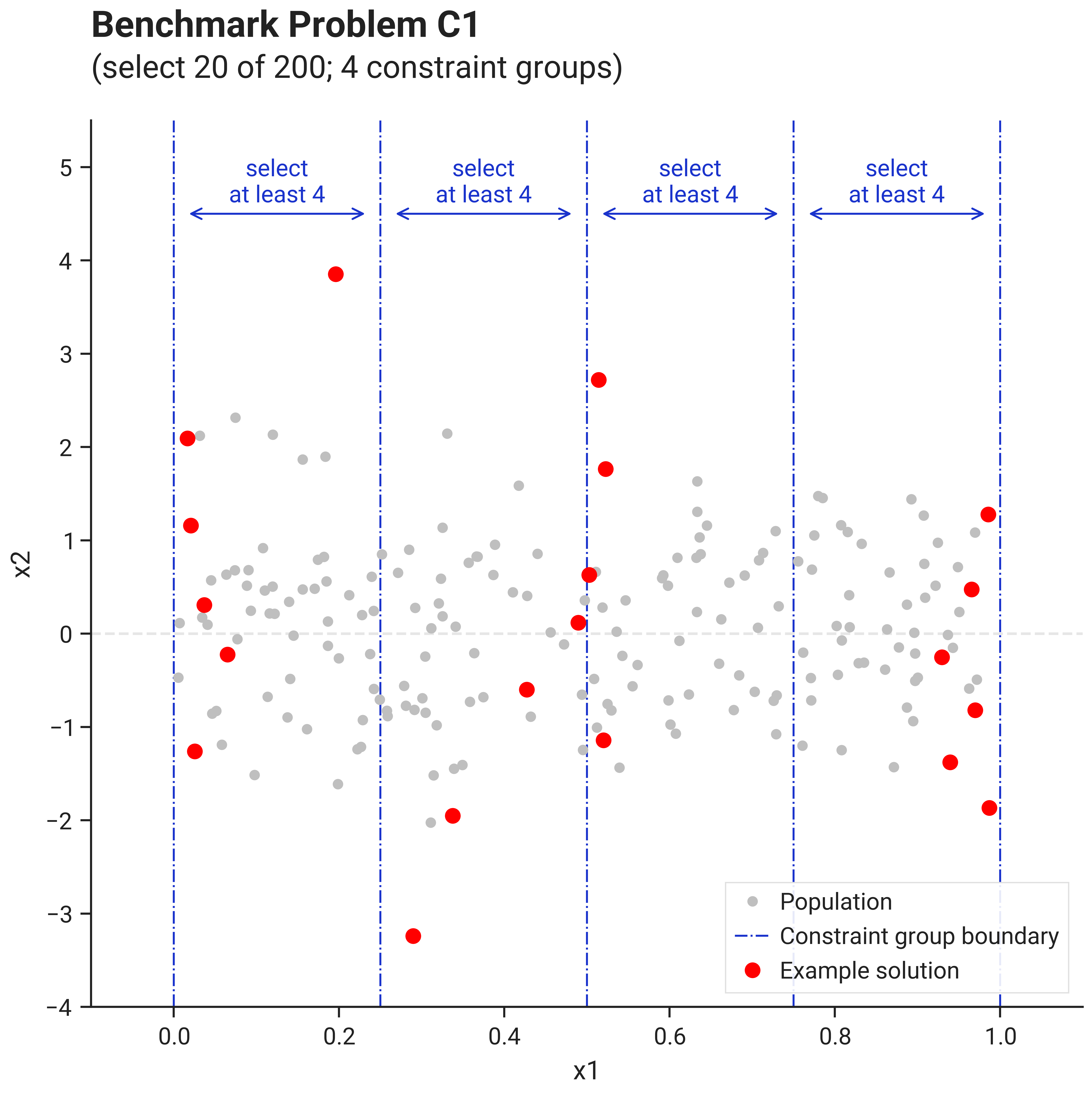
The image below shows an example solution, obtained by using the DEFAULT solver preset over 10.000 iterations
using the L2 distance metric and the geomean_separation diversity metric:
C. Separation statistics
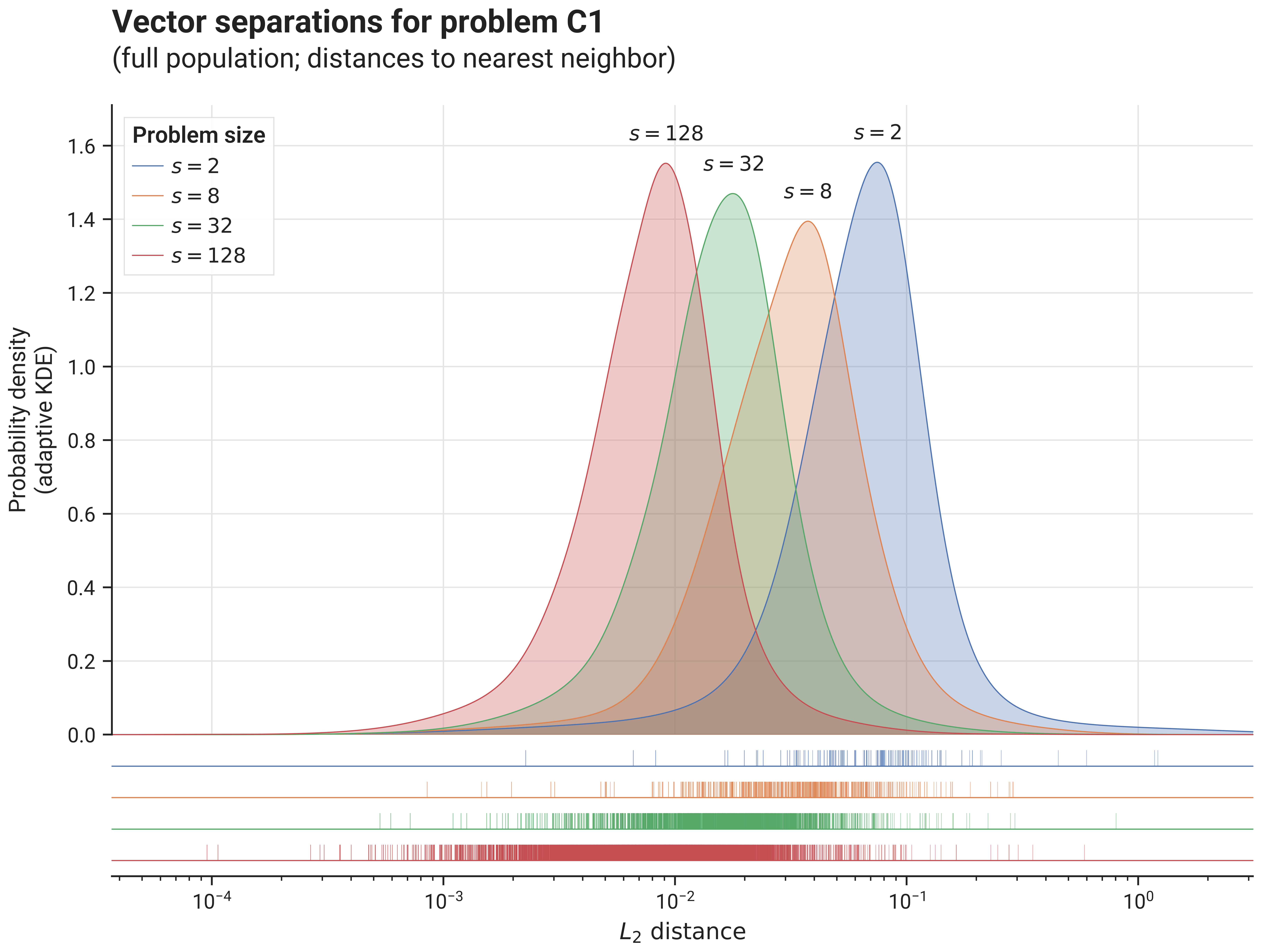
The image below shows distribution of vector separations (distances to nearest neighbor for all vectors in the population), for different problem sizes: