Benchmark Results - Problem C3
I. Problem Description
A. Overall Approach
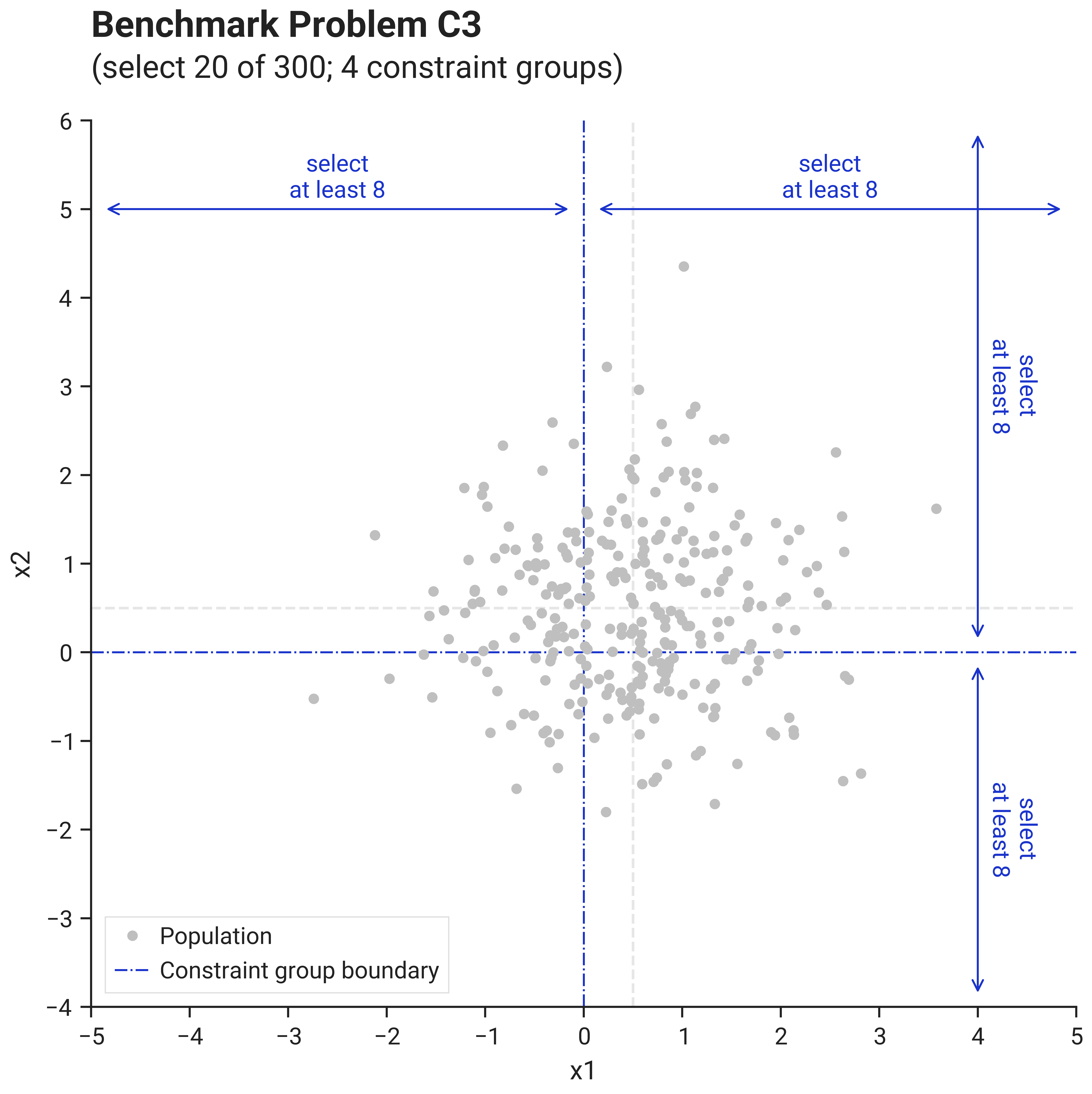
Vector components are drawn from a standard normal distribution \(\mathcal{N}(0.5, 1)\), i.e. centered around \(0.5\) and therefore have a probability of approximately \(\sim 69\%\) to be positive and \(\sim 31\%\) to be negative.
In each of the \(d=s\) dimensions, we split the vectors in \(2\) groups, based on the sign of that dimension's vector component:
- between \(\frac{4}{10}k\) and \(k\) vectors with positive component in that dimension need to be selected
- between \(\frac{4}{10}k\) and \(k\) vectors with negative component in that dimension need to be selected
For example, for \(s=2\) (\(d=2, n=300\)) we expect group sizes of approximately \(207\) and \(93\) vectors, from each of which \(8\) out of \(k=20\) vectors need to be sampled.
Note that in a single dimension, groups of that dimension do not overlap, but across dimensions, there is an intricate overlap between groups, creating \(2^d\) possible combinations of group membership, most of which are expected to be empty for large \(d\).
B. Visualization
This image shows problem C3 with size parameter \(s=2\) (thus \(d=2\), \(n=300\), \(k=20\), \(m=4\)):
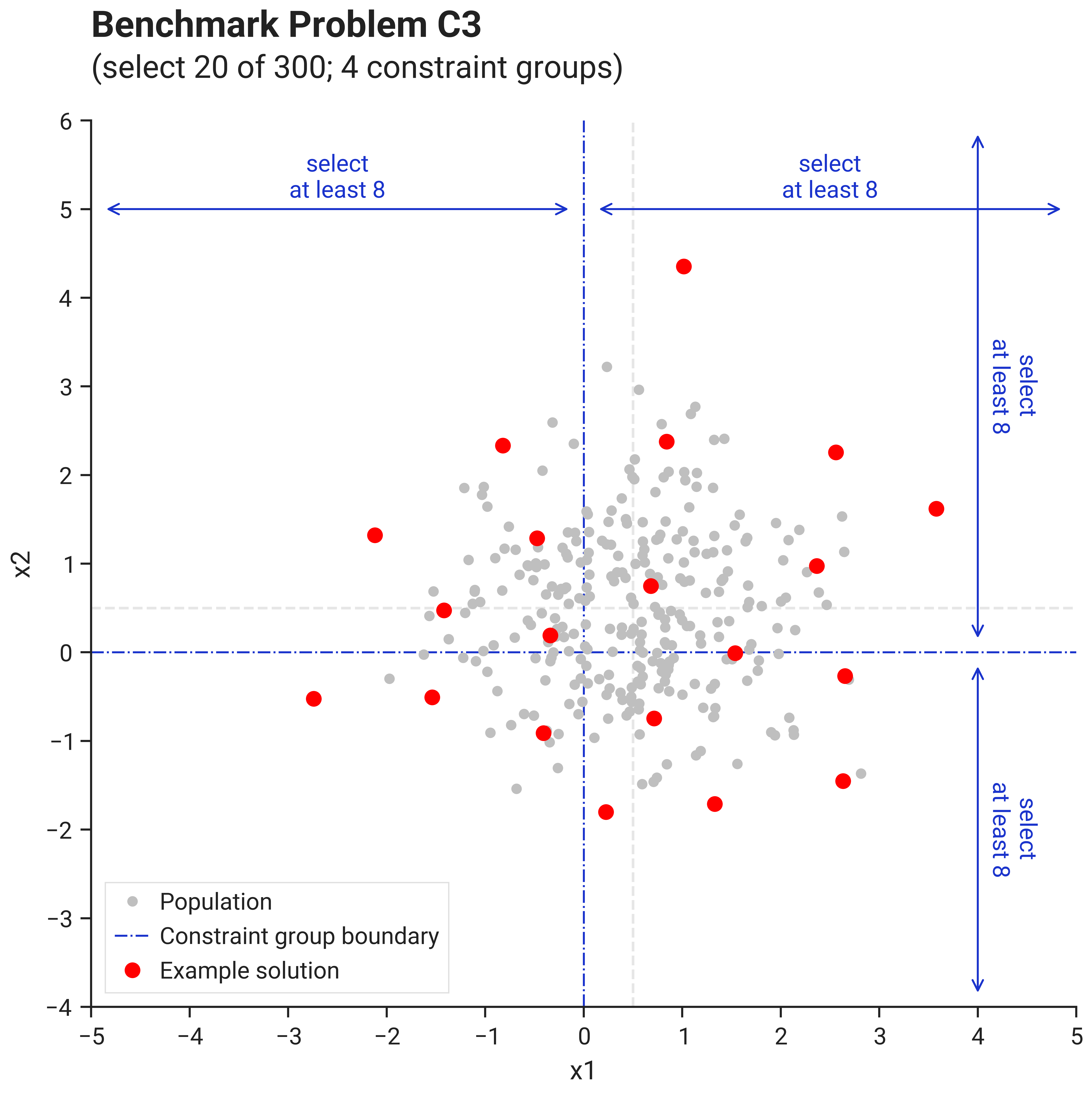
The image below shows an example solution, obtained by using the DEFAULT solver preset over 10.000 iterations
using the L2 distance metric and the geomean_separation diversity metric:
C. Separation statistics
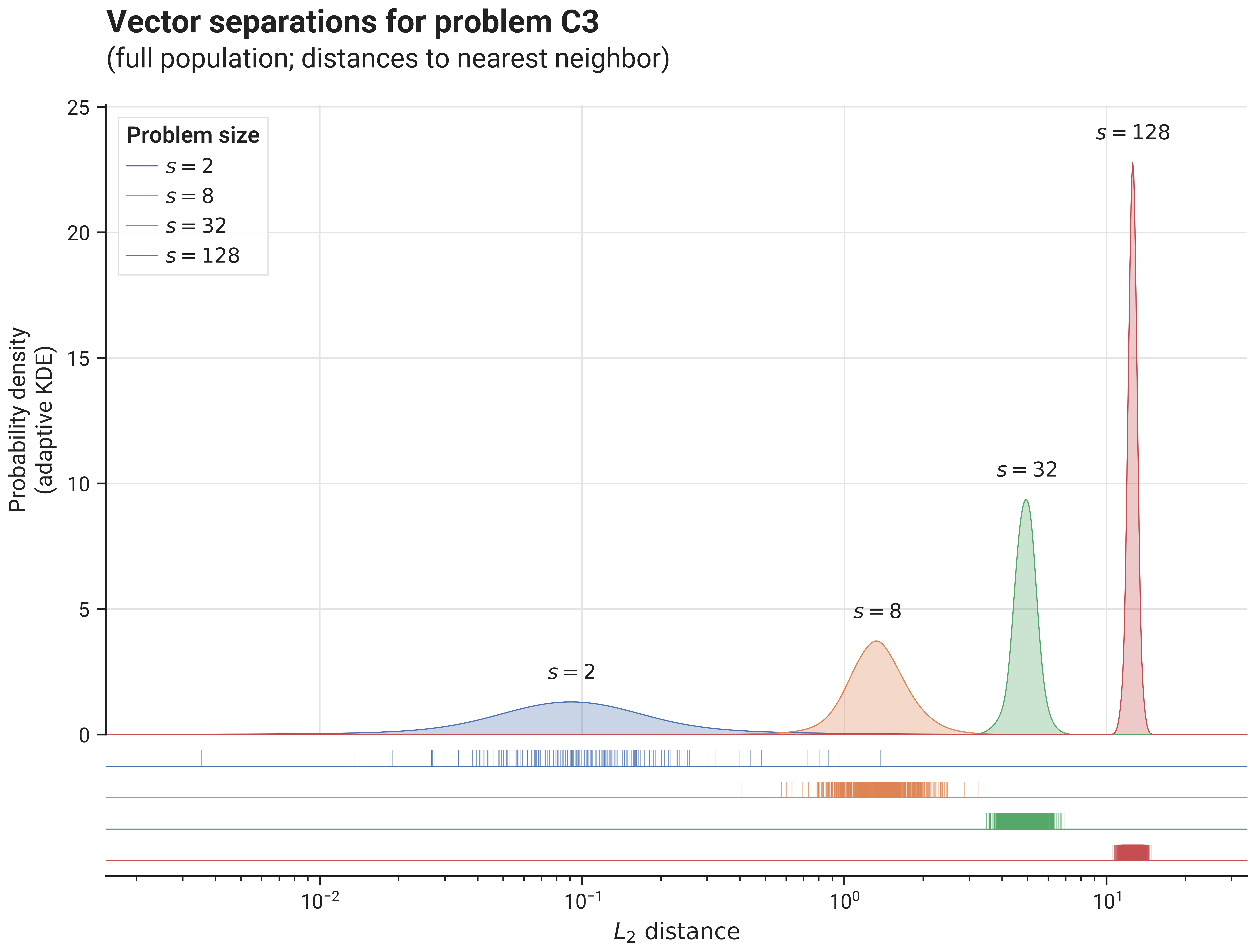
The image below shows distribution of vector separations (distances to nearest neighbor for all vectors in the population), for different problem sizes: